

Jeroen Dik is a Dutch performance-tuning specialist, business owner, and racing driver best known for building JDEngineering into a respected name among Volkswagen Group enthusiasts. His reputation comes from combining software calibration with mechanical understanding rather than treating ECU remapping as a simple power upgrade. That practical approach has connected his workshop with Volkswagen, Audi, SEAT, Škoda, and Porsche owners seeking tailored performance instead of generic tuning files.
His story also reaches beyond the workshop. A highly modified Volkswagen Golf Mk1 helped establish his name in European sprint competition, while a later campaign in the Toerwagen Diesel Cup proved his ability behind the wheel. In 2011, he secured the championship in a Volkswagen Golf 5. Together, those achievements explain why searches for Jeroen Dik often lead to equal interest in JDEngineering, VAG tuning, and Dutch motorsport history.
Who Is Jeroen Dik?
Jeroen Dik began tuning cars during the 1990s, when engine-management technology was becoming increasingly important to performance builds. According to JDEngineering, his early work centered on G60-powered Volkswagens. What started as a serious personal interest developed into full-time work as demand grew. That progression matters because the company’s identity was built around hands-on testing, repeated development, and deep familiarity with a relatively focused family of vehicles.
Rather than expanding into every make and engine type, JDEngineering concentrated on Volkswagen Group platforms. The company lists Volkswagen, Audi, SEAT, Škoda, and Porsche among its specialties and emphasizes VAG-specific diagnostic and programming equipment. This narrower focus supports a deeper understanding of shared engines, transmissions, control units, and platform behavior. It also helps explain why Dik became especially well known within the European Volkswagen and Audi tuning communities.
The main parts of his professional identity include:
- Founder and owner of JDEngineering
- Specialist in custom VAG tuning
- Developer of the Golf Mk1 16vG60
- Volkswagen racing driver
- 2011 Toerwagen Diesel Cup champion
- Advocate for vehicle-specific ECU calibration
How JDEngineering Became a VAG Tuning Leader
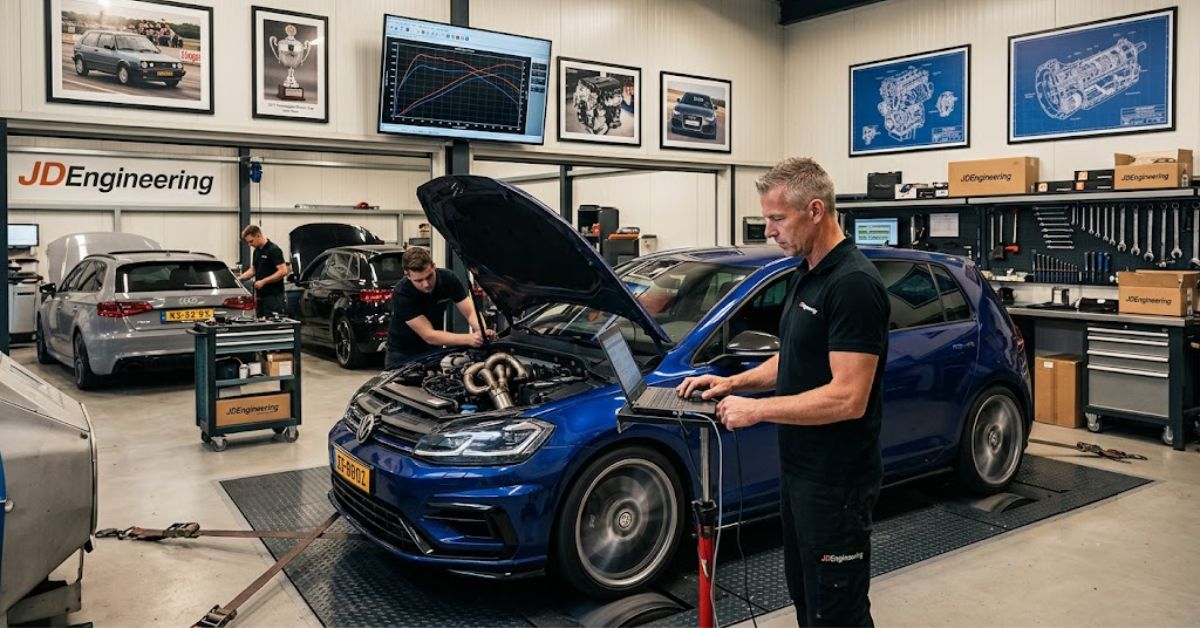
JDEngineering grew from Dik’s tuning work into a dedicated workshop in Lochem, the Netherlands. The official company history says the business expanded after its success with G60 models and the well-known Golf Mk1 project. Today, its public services include custom chiptuning, staged performance packages, DSG tuning, diagnosis, mechanical upgrades, and four-wheel-drive dyno testing. The business presents each calibration as an application-specific solution rather than a universal software product.
That distinction is central to the JDEngineering brand. A generic tune may be designed around an average example of an engine, but two cars of the same model can have different fuel quality, hardware, wear, cooling efficiency, or transmission limits. JDEngineering says it modifies original vehicle software while considering diagnostic logs and a reference calibration developed for the engine. This process aims to match the tune to the condition and configuration of the actual car.
| Area | JDEngineering’s Focus |
|---|---|
| Vehicle brands | Volkswagen, Audi, SEAT, Škoda, and Porsche |
| Core service | Custom ECU remapping and chiptuning |
| Transmission work | DSG and S tronic calibration |
| Testing equipment | Superflow four-wheel-drive dyno |
| Development method | Diagnostics, data logging, calibration, and testing |
| Vehicle types | Gasoline, diesel, and selected plug-in hybrid models |
The Legendary Golf Mk1 16vG60
The Golf Mk1 16vG60 became the project most closely associated with Dik’s early reputation. JDEngineering describes it as a 1.9-liter, 16-valve G60 build with an 8,000-rpm specification, a 60 mm toothed pulley, and eight injectors. The company also credits the car with winning numerous sprint events. Its combination of a light first-generation Golf shell and an aggressively developed supercharged engine made it memorable during the late 1990s tuning era.
More important than a single horsepower figure, the Golf demonstrated the value of integrating hardware and software. Airflow, fueling, ignition, boost control, temperature management, gearing, and traction all had to work together. That systems-based thinking still applies to modern ECU remapping. A car that produces an impressive peak number for one dyno pull may be less useful than one with controlled temperatures, repeatable delivery, and a broad torque curve that works on real roads.
| Golf Mk1 Feature | Why It Mattered |
|---|---|
| Lightweight Mk1 platform | Improved power-to-weight performance |
| 1.9-liter 16-valve engine | Combined displacement with high-rpm airflow |
| G60 supercharger | Delivered distinctive forced-induction performance |
| Eight-injector configuration | Supported the engine’s increased fuel demand |
| 8,000-rpm specification | Expanded the usable performance range |
| Sprint competition use | Tested the complete build under real load |
The project helped demonstrate three lasting performance principles:
- Software must match the engine hardware.
- Cooling and fueling are as important as boost.
- Usable power matters more than one peak dyno figure.
Jeroen Dik’s Motorsport Career
Dik’s motorsport record gave his tuning credentials an additional layer of authority. In the 2011 Toerwagen Diesel Cup, he raced a Volkswagen Golf 5 and scored consistently throughout the season. The official JDEngineering recap says he reached the podium at least once during every race weekend. At the Zandvoort finale, a second-place finish in the opening race gave him enough points to secure the championship before the final event began.
The title was not based on one dominant weekend. Contemporary race reports show a campaign built on speed, recovery drives, and steady scoring. He won the first Pinksterraces event after starting tenth and moving through the field over a 100-minute race. That kind of performance rewards mechanical reliability as much as outright pace. It also reflects a tuner’s awareness that a competition car must survive sustained heat, load, braking, and repeated acceleration.
Selected Career Milestones
| Period | Milestone |
|---|---|
| 1990s | Began tuning Volkswagen vehicles |
| Early business years | Developed JDEngineering from a personal interest |
| G60 era | Became known for Volkswagen G60 tuning |
| Golf Mk1 period | Won sprint events with the 16vG60 project |
| 2010 season | Finished one point short of the diesel championship |
| 2011 season | Won the Toerwagen Diesel Cup in a Volkswagen Golf 5 |
The 2010 result and 2011 title are documented by JDEngineering’s championship account, which says Dik had missed the previous title by only one point.
His Approach to Custom ECU Remapping
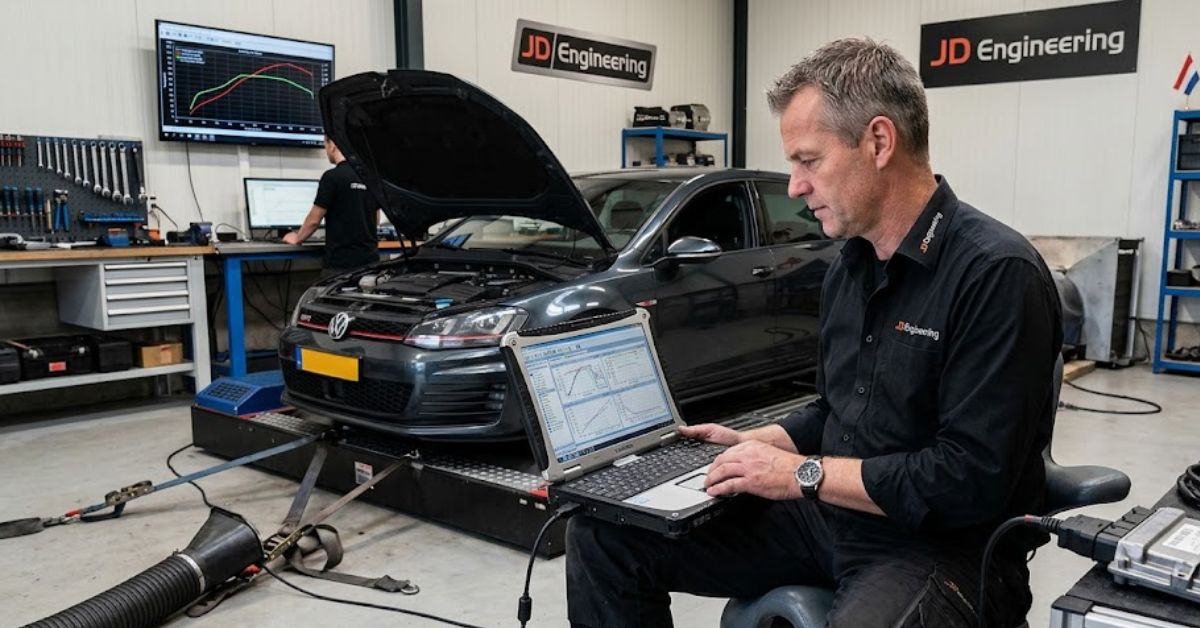
JDEngineering’s published workflow begins with vehicle diagnosis and data collection. The original software is then adjusted with reference to logs and the workshop’s established calibration for that engine. Depending on the package, development may include road diagnosis, transmission software, and custom work on the four-wheel-drive dyno. In simple terms, the process measures how the car behaves, changes selected control strategies, and verifies whether the result remains stable under load.
This approach separates responsible VAG tuning from headline-driven horsepower chasing. Power and torque remain important, but so do air-fuel control, ignition timing, boost behavior, exhaust temperature, cooling capacity, transmission protection, and drivability. The best result depends on the owner’s goals and the car’s hardware. A daily-driven Audi, a track-focused Golf, and a plug-in hybrid Porsche may require very different torque delivery even when each owner asks for stronger performance.
Custom Tuning Process
- Inspect the vehicle: Check the engine, transmission, fault codes, and supporting hardware.
- Record baseline data: Measure current behavior and identify existing problems.
- Read the original software: Preserve the factory calibration before making changes.
- Adjust the calibration: Modify relevant torque, boost, ignition, fuel, and protection strategies.
- Test the result: Use diagnostic logs, road testing, or dyno testing under load.
- Review consistency: Confirm that the car delivers repeatable performance without unstable behavior.
Custom ECU Remapping vs. Generic Tuning
| Custom Calibration | Generic Tuning File |
|---|---|
| Considers the individual vehicle | Designed for an average vehicle |
| Uses diagnostic logs | May involve limited data collection |
| Can reflect hardware changes | Usually assumes standard hardware |
| Allows torque-delivery adjustments | Often uses preset targets |
| Can be verified on a dyno | May not include measured validation |
| Better suited to unusual builds | Better suited to basic applications |
Responsible Tuning Checklist
- Complete diagnostics before tuning
- Confirm that the engine has no major faults
- Inspect the cooling and fuel systems
- Match the software to installed hardware
- Respect transmission torque limits
- Monitor temperatures under sustained load
- Test drivability at low and high engine speeds
- Verify results instead of relying on estimated gains
JDEngineering’s Workshop and Dyno Technology
The Lochem facility uses an in-house Superflow four-wheel-drive rolling road for special tuning, custom calibration, power measurement, and software-stage development. A 4WD dyno allows the team to test vehicles that distribute power through multiple axles while monitoring performance in a controlled setting. JDEngineering also publishes tuning options for recent engines, DSG and S tronic transmissions, and selected plug-in hybrid models, showing how its work has moved beyond early G60 platforms.
Modern vehicles make that work more complex. Their powertrains combine protected engine computers, torque-based control, emissions systems, networked modules, adaptive transmissions, and extensive fault monitoring. Successful calibration therefore requires more than raising boost or changing one fuel map. The workshop’s continued VAG focus gives it a defined technical territory, while the dyno and diagnostic workflow provide ways to validate changes before a customer relies on them during everyday driving.
A dyno can help a tuning workshop:
- Establish baseline horsepower and torque
- Reproduce load in a controlled environment
- Examine the shape of the torque curve
- Monitor temperatures and diagnostic values
- Compare results before and after calibration
- Detect unstable power delivery
- Develop software for specific engines and modifications
Dyno figures should still be interpreted carefully. Different machines, correction methods, temperatures, tires, and test procedures can produce different numbers. Consistency on the same equipment is often more valuable than comparing one workshop’s peak result with a figure produced elsewhere.
Conclusion
Jeroen Dik’s importance comes from the way his career links three parts of performance culture: memorable project cars, specialized engineering work, and competitive racing. The Golf Mk1 16vG60 created an early reputation, JDEngineering turned that expertise into a focused business, and the 2011 Toerwagen Diesel Cup title demonstrated consistent performance under race conditions. Each chapter reinforces the others and gives his name lasting relevance among Volkswagen Group enthusiasts.
For readers discovering Jeroen Dik today, the clearest takeaway is not simply that he made fast cars. His work represents a measured form of performance tuning in which diagnostics, calibration, supporting hardware, heat management, and reliability must operate as one system. That philosophy remains useful as VAG platforms become more advanced, because modern speed depends as much on data and control strategy as it does on traditional mechanical modification.